| Ever Obtained Chispitas | ||
| Variable: chispitas_vez | Lifetime exposure to supplementation program | ||
| Response | N (survey) | Percentage |
|---|---|---|
| Yes, ever obtained | 961 | 85.7% |
| No, never obtained | 142 | 12.7% |
| Missing | 13 | 1.2% |
| Don't know | 3 | 0.3% |
| Prescribed but not obtained | 2 | 0.2% |
| Source: SIVESNU 2018 | Note: Survey-weighted estimates using expanded sample. | ||
Integrating Micronutrient Supplementation
Module 4: Covariate Prediction
Overview
Guatemala’s Chispitas program distributes Multiple Micronutrient Powders (MNP) to children 6–59 months through the public health system. These sachets provide iron, zinc, and other micronutrients that complement dietary intake — a critical intervention in a population where maize-based diets often fall short of requirements.
To accurately model the relationship between nutrient intake and stunting risk, we must account for supplementation alongside dietary intake. This requires understanding not just program coverage, but actual consumption patterns: Did the household receive Chispitas? Did caregivers administer them? How much of each sachet was consumed?
This module integrates Chispitas contributions through a three-level adherence cascade:
- Access — Did the household obtain Chispitas?
- Administration — Did caregivers give sachets to the child?
- Dosing compliance — What proportion of each sachet was consumed?
Chispitas Program Context
Nutritional Composition
Each Chispitas sachet contains 15 micronutrients following WHO/UNICEF MNP specifications. For this analysis, we focus on iron and zinc — the micronutrients most relevant to stunting and directly comparable to biofortified maize improvements (Instituto de Nutrición de Centro América y Panamá et al., 2016).
| Micronutrient | Content per Sachet |
|---|---|
| Iron (ferrous fumarate) | 10 mg |
| Zinc (zinc gluconate) | 4.1 mg |
Distribution Protocol
The program distributes 60 sachets every ~180 days, intended for daily consumption during 60 consecutive days. To convert this episodic pattern to average daily intake (compatible with 24-hour recall methodology), we apply a 1/3 adjustment:
- Effective daily Fe: 10 mg × 1/3 = 3.33 mg/day
- Effective daily Zn: 4.1 mg × 1/3 = 1.37 mg/day
Population and Variable Preparation
Target Population
Chispitas are indicated for children 6–59 months — old enough for complementary feeding (where sachets are mixed into food) but within the critical window for micronutrient intervention. Children under 6 months are excluded as exclusive breastfeeding is assumed during this period.
Adherence Variables
SIVESNU 2018 (Instituto de Nutrición de Centro América y Panamá, 2020) captures supplementation behavior through four key variables:
| Variable | Question | Cascade Level |
|---|---|---|
chispitas_vez |
Ever obtained Chispitas? | Level 1: Access |
chispitas_6mes |
Obtained in last 6 months? | Level 1b: Recent access |
chispitas_todo_parte |
Gave sachets to child? | Level 2: Administration |
chispitas_sobresdelpaquete |
How much of sachet consumed? | Level 3: Dosing |
NoteVariable Interpretation
For chispitas_6mes, NA values indicate no barrier reported (access maintained), not missing data. Only explicit “no” responses indicate access interruption. This interpretation follows the official SIVESNU 2018 report coding (INCAP, 2020).
Adherence Cascade Analysis
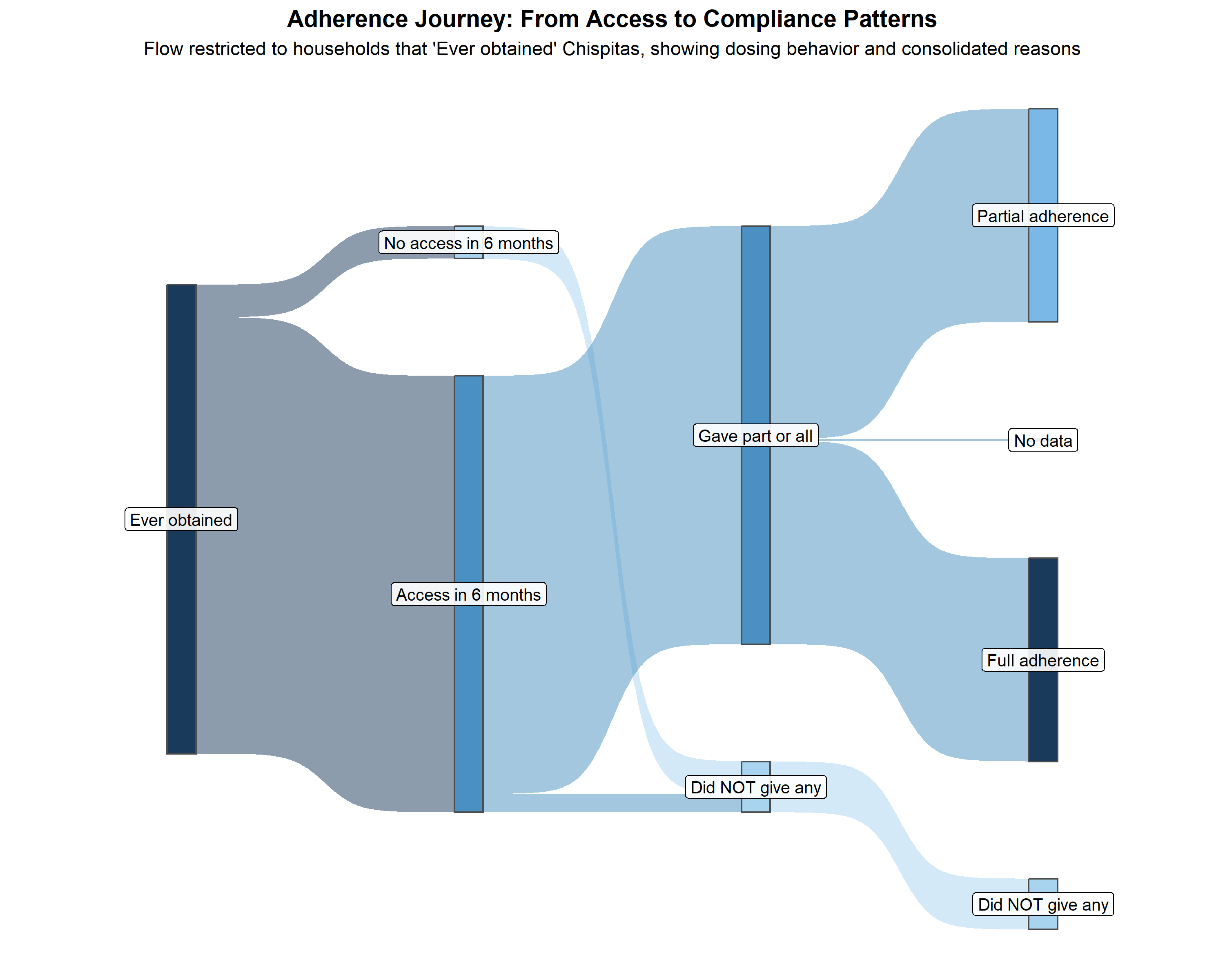
The cascade quantifies attrition at each stage from program access to actual consumption of micronutrient powder. Each level filters the population, and the final effective coverage is the one that remains after cumulative dropout.
Level 1: Lifetime Access
Level 1b: Recent Access (Last 6 Months)
| Access Status in Last 6 Months | ||
| Variable: chispitas_6mes | Among households that ever obtained Chispitas | ||
| Access Status | N (survey) | Percentage |
|---|---|---|
| Access in 6 months | 896 | 93.2% |
| No access in 6 months | 65 | 6.8% |
| Source: SIVESNU 2018 | Note: NA values interpreted as 'access maintained' per official SIVESNU report coding. | ||
Level 2: Administration
| Dosing Compliance Status | ||
| Variable: chispitas_todo_parte | Among households with Chispitas access | ||
| Dosing Behavior | N (survey) | Percentage |
|---|---|---|
| Gave part or all of the sachets | 866 | 93.1% |
| Missing | 33 | 3.5% |
| Did NOT give any sachets | 31 | 3.3% |
| Source: SIVESNU 2018 | Note: Analysis restricted to households with confirmed Chispitas access. | ||
Level 3: Dosing Compliance
| Sachet Consumption Quantity | ||
| Variable: chispitas_sobresdelpaquete | Among households that administered Chispitas | ||
| Quantity Consumed | N (survey) | Percentage |
|---|---|---|
| All | 457 | 49.6% |
| More than half | 115 | 12.5% |
| Half | 105 | 11.4% |
| Less than half | 242 | 26.2% |
| Missing | 3 | 0.3% |
| Source: SIVESNU 2018 | Note: Full compliance (highlighted) indicates child received 100% of intended micronutrient dose. | ||
Cascade Visualization
Nutritional Integration
Adherence Factor Assignment
Children who received Chispitas are assigned adherence factors based on reported dosing compliance:
| Dosing Compliance | % of Recipients | Adherence Factor |
|---|---|---|
| All | 49.6% | 1.00 |
| More than half | 12.5% | 0.75 |
| Half | 11.4% | 0.50 |
| Less than half | 26.2% | 0.25 |
NoteInterpreting Adherence Factors
These factors represent the proportion of each sachet consumed per administration event, not temporal adherence. A child receiving “half the sachet” daily receives approximately 50% of the intended micronutrient dose during supplementation periods.
The effective daily contribution combines the protocol adjustment (1/3) with individual adherence. For example:
- Full compliance: 10 mg Fe × 1/3 × 1.00 = 3.33 mg Fe/day.
- Half compliance: 10 mg Fe × 1/3 × 0.50 = 1.67 mg Fe/day.
Integration Summary
| Chispitas Supplementation Summary | |
| Effective coverage and nutrient contribution (children 6-59 months) | |
| Indicator | Value |
|---|---|
| Total children (6-59 months) | 1,121.00 |
| Chispitas recipients | 866.00 |
| Recipients (%) | 77.25 |
| Mean adherence factor (all children) | 0.56 |
| Mean effective Fe contribution (mg/day) | 1.85 |
| Mean effective Zn contribution (mg/day) | 0.76 |
| Mean adherence factor (recipients only) | 0.72 |
| Source: SIVESNU 2018 | Note: Recipients = children with access who received part or all of sachets. | |
TipWhy Integrate into Non-Maize?
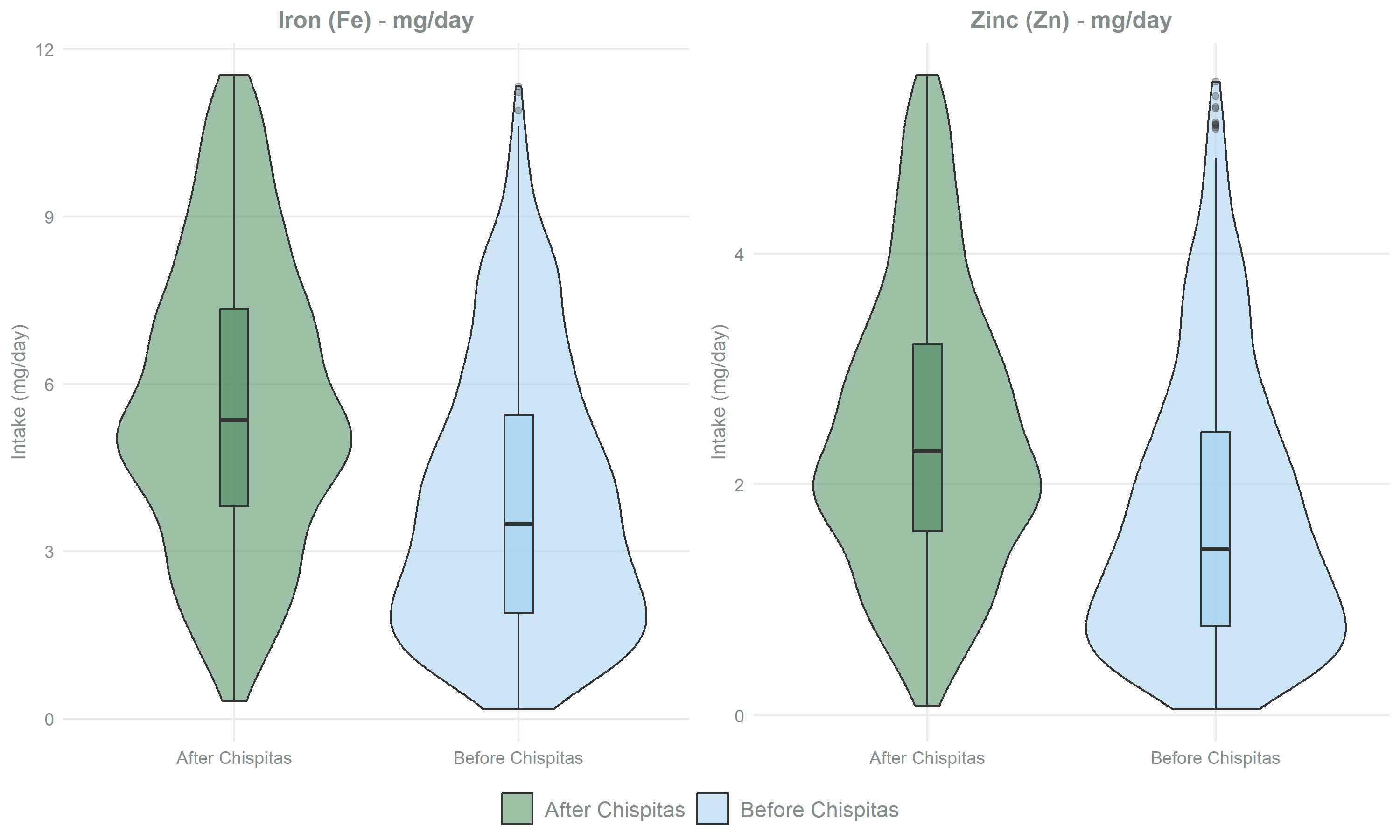
Chispitas are added to the non-maize intake component to maintain separation between dietary sources. This structure enables direct comparison: biofortification modifies the nutrient composition of maize, while supplementation modifies the non-maize totals.
Validation
Summary
Cascade Results
| Level | Filter | Retention |
|---|---|---|
| Access (lifetime) | Ever obtained Chispitas | 85.7% |
| Access (6 months) | Maintained access | 93.2% of above |
| Administration | Gave sachets | 93.1% of above |
| Dosing | Full compliance | 49.6% of recipients |
The weighted average adherence factor among recipients is 0.72. At the population level (including non-recipients), the mean adherence factor is 0.56.
Key Findings
High program reach — 86% of children 6–59 months have accessed Chispitas at some point, indicating broad program reach.
Administration gap — 7% of households with access did not administer sachets to children, representing an intervention opportunity.
Partial compliance common — Among recipients, 49.6% consumed full sachets, 12.5% more than half, 11.4% half, and 26.2% less than half.
SIVESNU vs official rates — Observed coverage in our sample exceeds official MSPAS reports (Ministerio de Salud Pública y Asistencia Social, 2023), likely due to SIVESNU sampling characteristics. This discrepancy will be adjusted during synthetic population generation.
References
Instituto de Nutrición de Centro América y Panamá. (2020). Informe del Sistema de Vigilancia Epidemiológica de Salud y Nutrición -SIVESNU- agosto 2018 – abril 2019 – Módulo 2: Salud y nutrición infantil. INCAP.
Instituto de Nutrición de Centro América y Panamá, Food and Nutrition Technical Assistance III Project, & Proyecto Nutri-Salud/URC. (2016). Diplomado Nutrición materno-infantil en los primeros 1,000 días de vida. Unidad 4: Alimentación complementaria a partir de los 6 hasta los 24 meses. INCAP/FANTA/URC.
Ministerio de Salud Pública y Asistencia Social. (2023). Suplementación en niños menores 5 años 2013 a 2023. Portal de Datos Abiertos MSPAS Guatemala.